

How Omnichannel Fulfillment Improves the Customer Experience
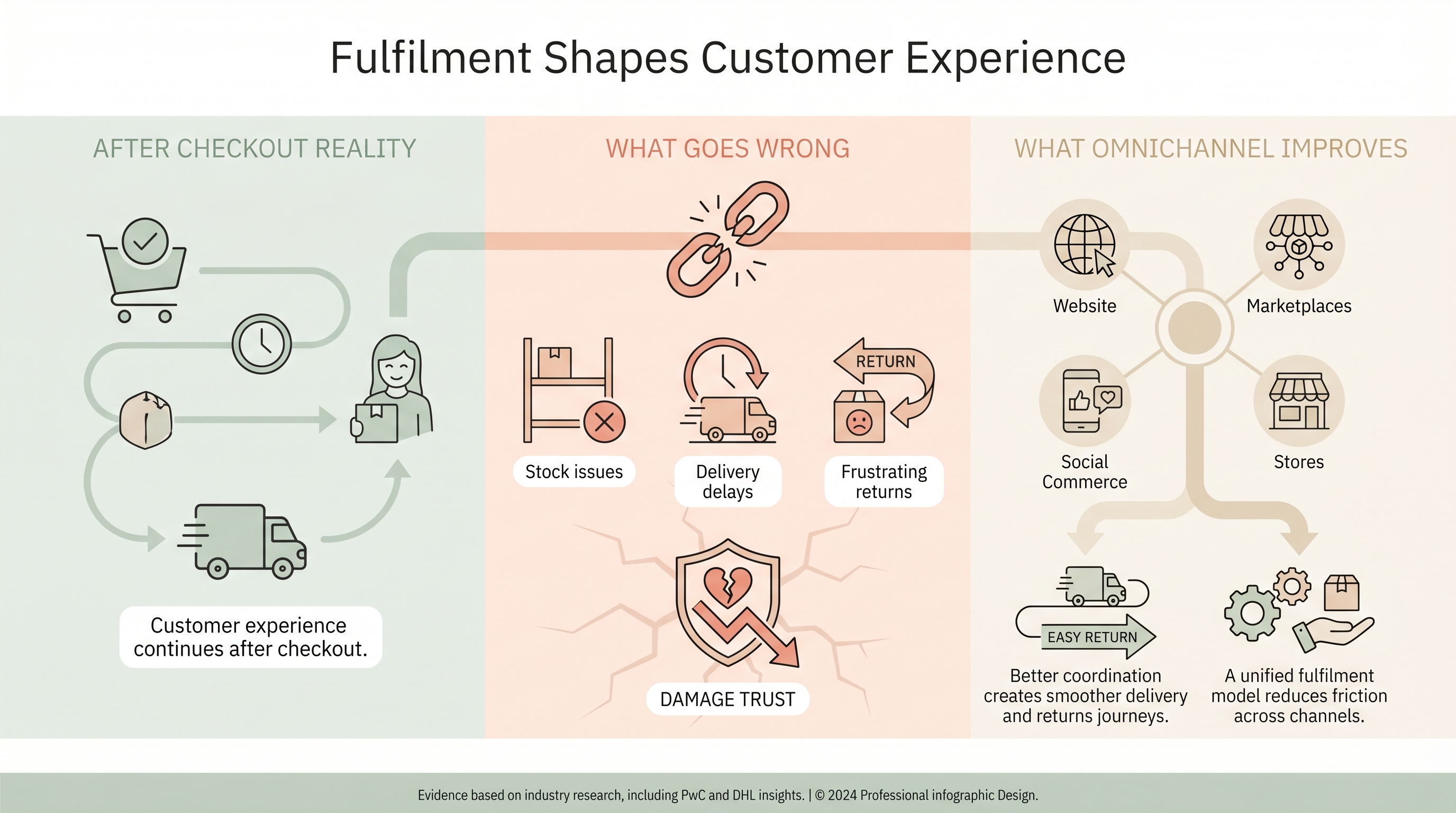
Customer experience in e-commerce is often judged by the front end. We talk about product pages, checkout flow, paid ads, and website design. But many of the moments customers remember most happen after they place the order.
If stock is inaccurate, delivery is slow, or returns are frustrating, the experience quickly breaks down. That matters commercially. PWC’s 2025 Customer Experience Survey found 52% of consumers stopped buying from a brand after a bad product or service experience, while 29% stopped because of poor customer experience online or in person.
DHL’s 2025 e-commerce research found that delivery and returns remain major drivers of cart abandonment. 81% of shoppers would abandon a purchase if their preferred delivery option was not available, and 79% if the returns process did not meet expectations.
That is why I would frame omnichannel fulfillment as a customer experience lever, not just an operations model. In simple terms, omnichannel fulfillment connects inventory, order routing, and fulfilment workflows across your website, marketplaces, social commerce channels, and physical locations.
Instead of treating each channel as a fulfilment island, we create a unified system that enables better stock accuracy, faster order delivery, and smoother customer returns.
For the fuller definition, I would keep this section short and link to your pillar page on omnichannel fulfillment rather than expanding the explanation here.
Key Takeaways
- Omnichannel fulfillment directly enhances customer experience by reducing post-checkout friction, resulting in improved stock accuracy, faster delivery, fewer cancellations, and easier returns.
- Faster and more flexible delivery options are now part of the experience customers expect, not a nice-to-have. When those options are missing, many shoppers leave before completing the purchase.
- Returns are as important as delivery. A poor returns process can damage trust even if the initial sale went smoothly.
- Connected fulfilment also supports a more consistent brand experience across channels. Customers may browse on one platform and buy on another, but they still expect the same standard of service.
- If your fulfilment setup centralises customer and order data across multiple systems or partners, PDPA obligations apply. This means you must ensure compliance with data collection, disclosure, protection, and management requirements, especially when involving third parties such as logistics or cloud providers.
What is Omnichannel Fulfillment?
Omnichannel fulfillment connects your inventory, orders, shipping, and returns across every sales channel so customers get a smoother and more consistent buying experience, whether they shop on your website, marketplaces, social commerce platforms, or in-store. For a fuller explanation of how omnichannel fulfillment works, you can read our complete guide here: [insert pillar page link].
Why customer experience depends on fulfilment
Customer experience in e-commerce hinges on fulfilment. While it is easy to focus on pre-checkout elements, what customers remember most is whether orders are unavailable, delayed, or difficult to return. Fulfilment is where trust is built or lost.
Fulfilment determines whether customers trust a brand enough to come back. Investments in awareness and conversion fall short if post-purchase experiences are unreliable. PwC’s 2025 survey shows failures in fulfilment directly affect retention and future buying behaviour.
Faster delivery and better stock visibility
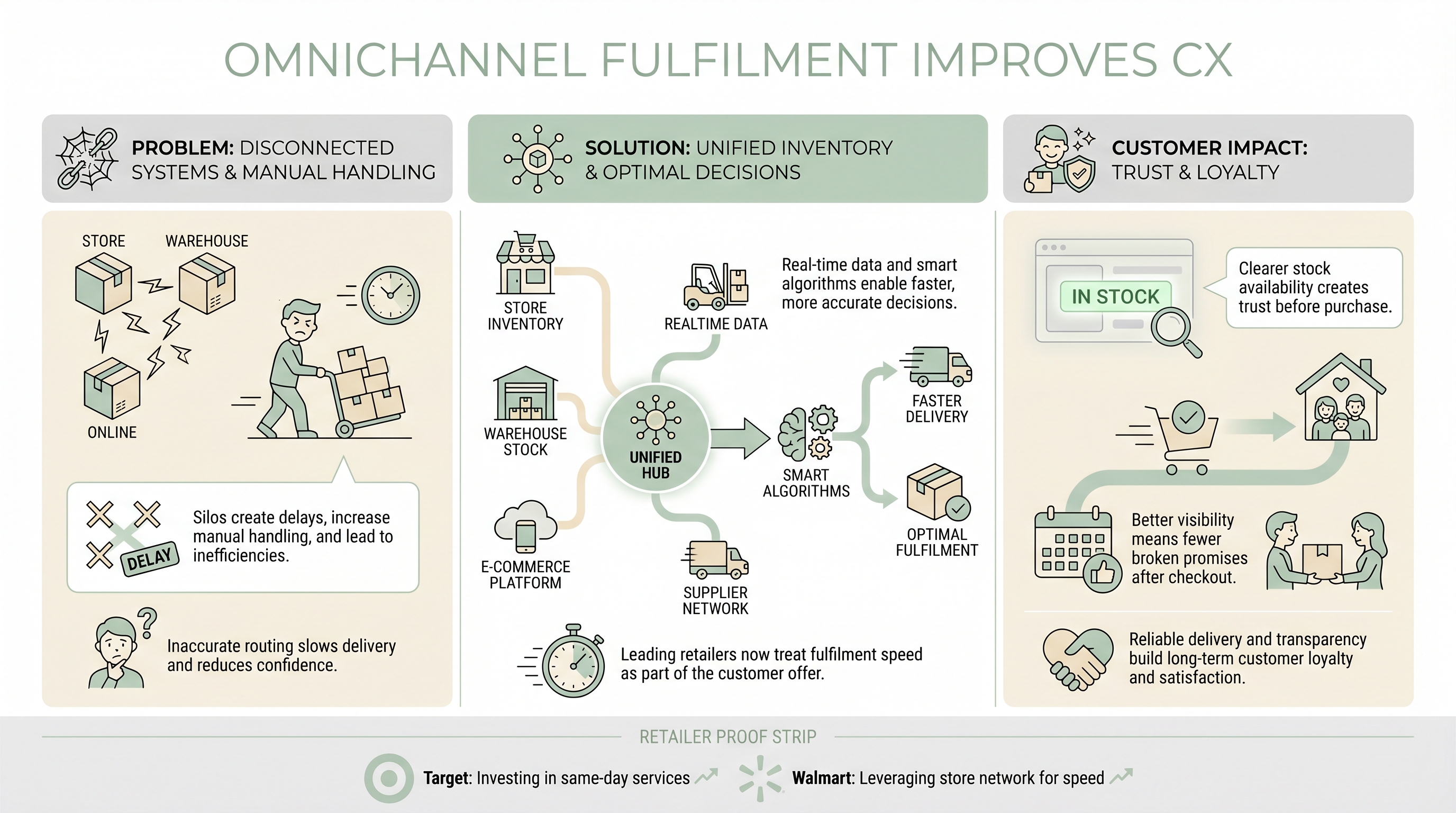
Image Credit: Generated by Genspark
One of the clearest ways omnichannel fulfillment improves customer experience is by helping brands deliver faster while showing customers more reliable stock information before they buy.
When orders are managed across disconnected systems, manual handling and slower routing increase the risk of delays. Connecting inventory and order data enables more efficient order routing and optimal fulfilment decisions, reducing delivery times and making the process smoother for customers.
This is not just theory. Major retailers have made connected fulfilment part of the customer offer itself. Target’s 2024 Annual Report, published in March 2025, said that it fulfilled over 65% of digital sales through same-day fulfilment options such as Order Pickup, Drive Up, and Same Day Delivery. Walmart’s 2025 Form 10-K said that substantially all its US stores provide same-day pickup and delivery.
The point is not that every brand needs Target or Walmart scale. The point is that leading retailers increasingly treat fulfilment speed and flexibility as part of the customer experience, rather than merely a matter of warehouse efficiency.
Stock visibility matters just as much. Customers want confidence that what they see at checkout matches what they get. If a website says an item is available, but it’s already sold out elsewhere, that's a broken promise. Omnichannel fulfillment bridges this gap by providing a clearer view of availability across channels, reducing friction before purchase and disappointment after.
Fewer cancellations and out-of-stock issues
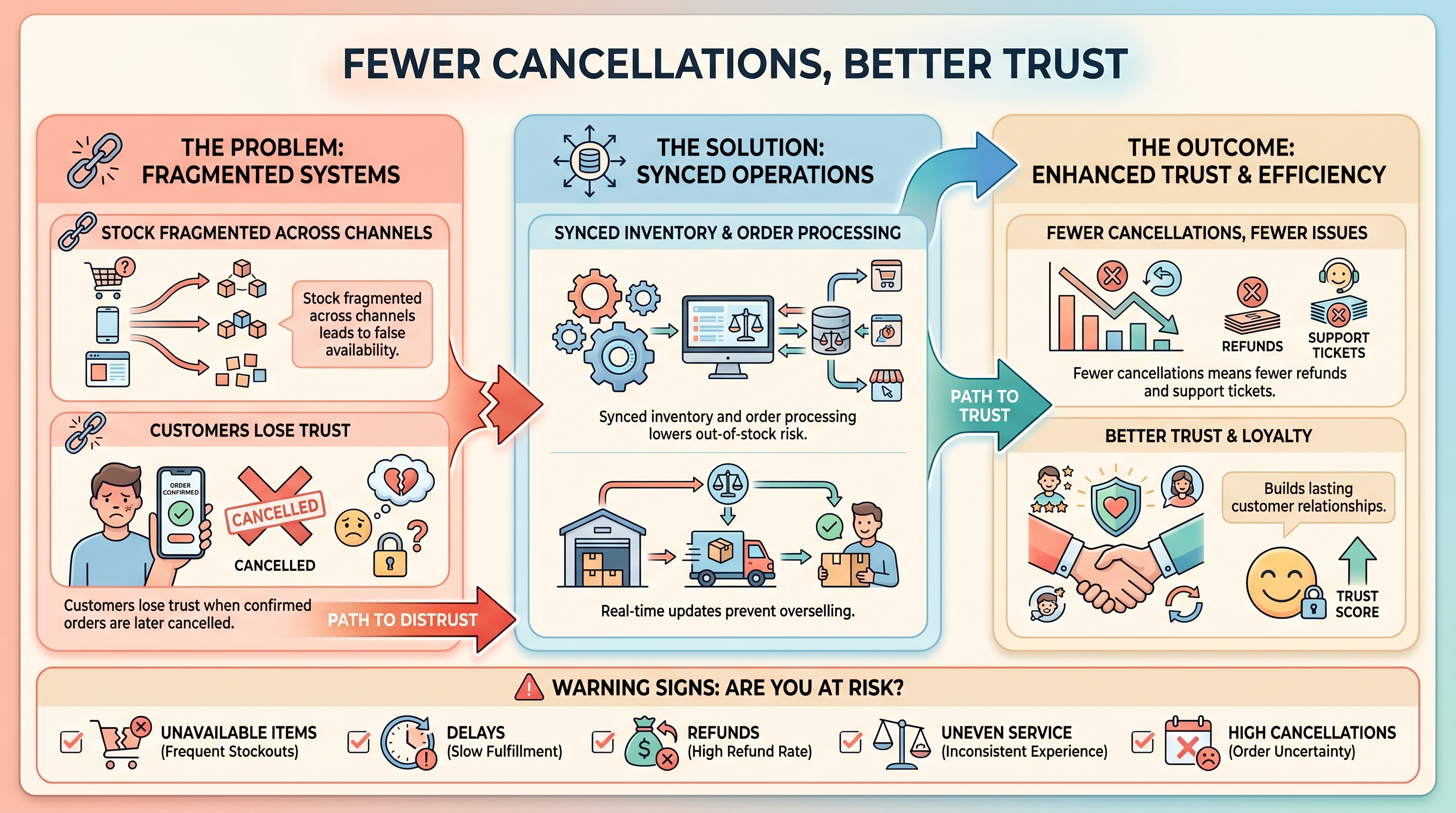
Image Credit: Generated by Genspark
Few things damage trust faster than an order confirmation followed by a cancellation email.
This happens most often when stock is fragmented across channels or updated too slowly. A customer sees the product as available, pays for it, and later finds out it cannot be fulfilled. From the customer’s perspective, that is not an inventory reconciliation problem. It is a poor experience.
Omnichannel fulfillment reduces this risk by syncing stock visibility and order processing more closely across channels.
If stock accuracy improves, customers are less likely to order unavailable products, and brands are less likely to cancel accepted orders. That leads to fewer support tickets, fewer refunds, and fewer moments that make the customer question whether the brand is dependable.
Quick checklist: signs your fulfilment setup is hurting customer experience
Customers regularly order items that later turn out to be unavailable
Delivery times vary too much between channels
Orders are accepted before the stock is properly confirmed
Support tickets about delays, stock issues, or refunds keep increasing
Customers get different service standards depending on where they buy
If you recognise several of these, the issue may not be your marketing. It may be the gap between channels and fulfilment systems.
Easier returns and exchanges
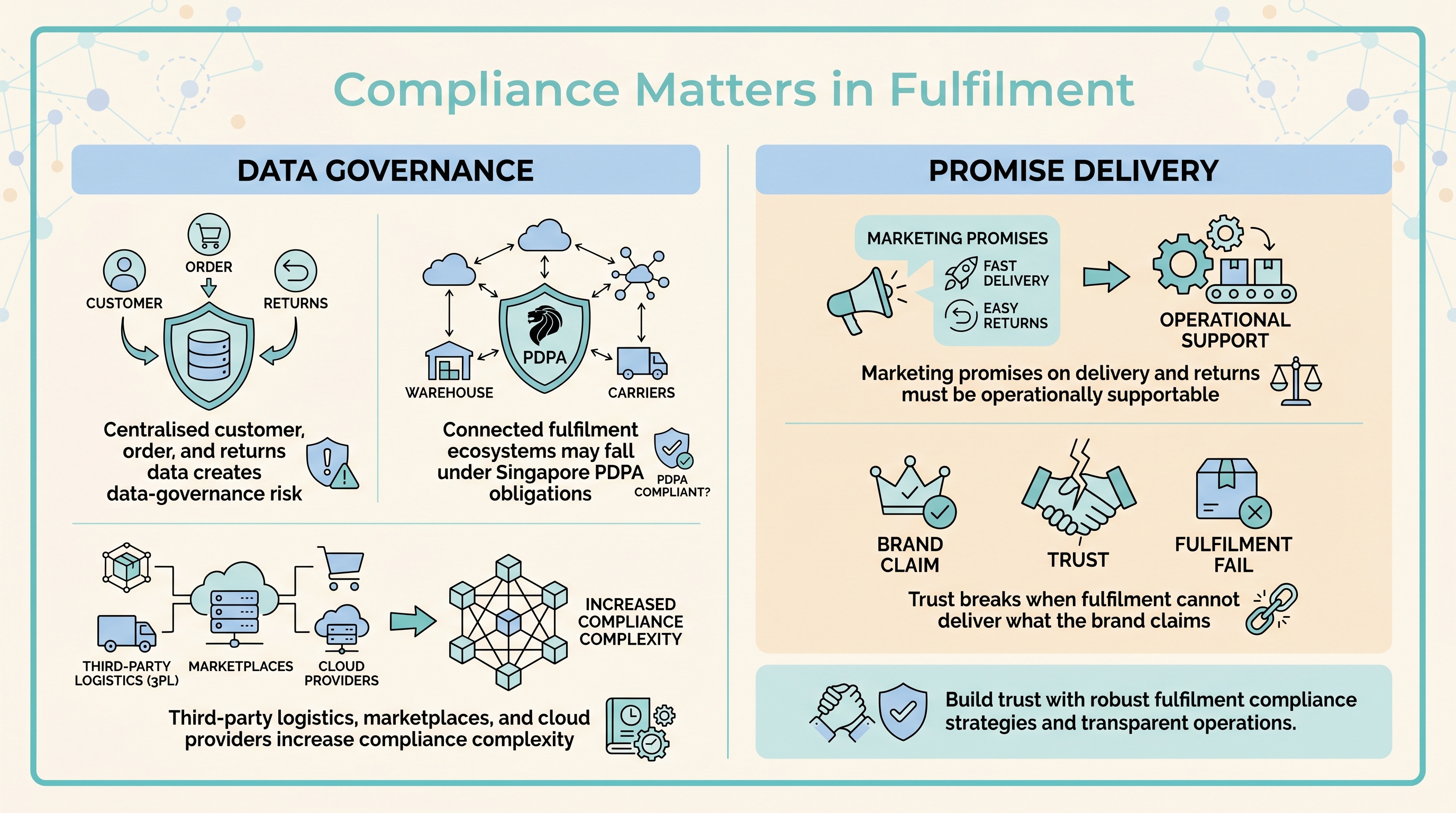 Image Credit: Generated by Genspark
Returns and exchanges truly test customer experience, as this is where friction is felt most sharply. Even a strong initial sale can be undermined by a slow or confusing return.
DHL’s 2025 e-commerce trends research shows that shoppers are highly sensitive to return expectations, and mismatches in processes can prompt abandonment. Increasingly, customers judge the experience by both the ease of ordering and, if needed, the ease of reversing a purchase.
In Singapore, this has practical relevance too. CASE announced in 2023 that Shopee committed to an average resolution time of two and a half working days for returns and refunds requests, improving on CASE’s seven-day recommendation in its Standard Dispute Management Framework for e-marketplaces.
That is a useful benchmark because it shows how strongly customer experience is tied to post-purchase responsiveness and dispute handling, not just initial fulfilment.
For brands, omnichannel fulfillment makes returns easier because order and stock records are more visible across the business. Staff can verify purchases more quickly, confirm replacement availability more accurately, and process exchanges with less back-and-forth. For customers, that translates into a simpler, more reliable returns experience.
More consistent cross-channel experiences
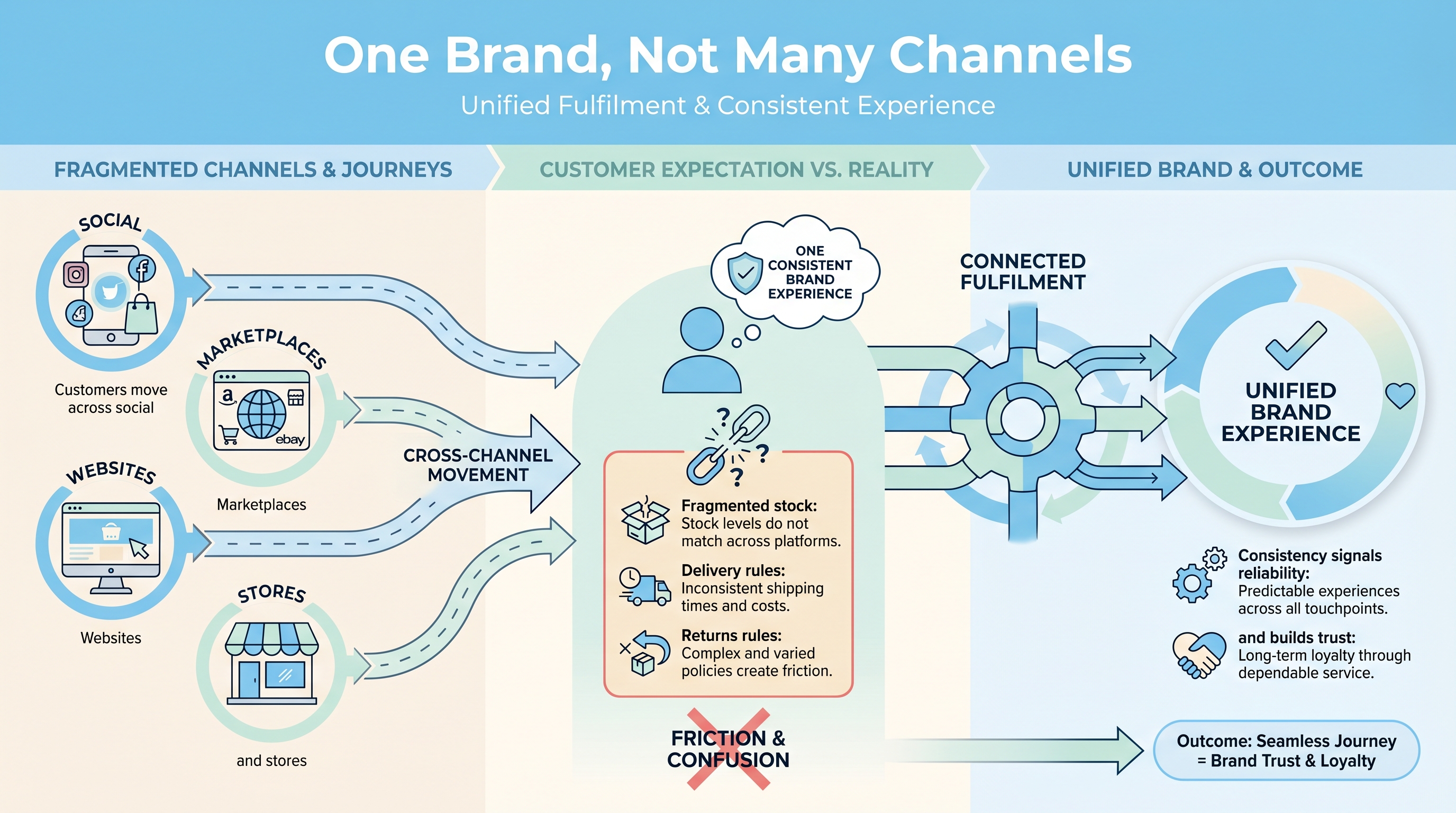 Image Credit: Generated by Genspark
Customers do not think in channels. They think in brands.
A customer may discover a product on social media, compare it on a marketplace, then buy it through your website or a physical store.
They still expect the same level of accuracy, reliability, and service. If stock visibility changes without explanation, delivery expectations differ wildly, or one channel handles returns very differently from another, the brand experience feels fragmented.
Omnichannel fulfillment helps address this by creating greater consistency behind the scenes. Inventory data, order status, and fulfilment logic are less likely to conflict across channels. That consistency matters because customers often interpret operational inconsistency as organisational unreliability.
Compliance and Regulations: Where They Matter
Not every e-commerce fulfilment article needs a heavy compliance section, but there are two areas where it is genuinely relevant.
First, when you centralise customer, order, and returns data across e-commerce platforms, marketplaces, warehouses, logistics partners, and cloud systems, you create a central data environment that falls under Singapore’s PDPA regulations.
Brands need to ensure personal data is handled in compliance with these legal requirements, considering the involvement of various third parties in the fulfilment process.
The PDPA framework sets out how organisations must collect, use, disclose, protect, retain, and, in some cases, transfer personal data. Specific PDPC guidance covers obligations for data intermediaries and cloud service providers, which are commonly involved in omnichannel fulfillment.
This is particularly relevant because third-party providers often process customer data across multiple systems for order management and logistics. This does not mean the article should become legal advice. It simply means brands should recognise that a connected fulfilment ecosystem also requires sound data governance.
Second, customer experience claims around delivery speed, returns promises, or order visibility should be operationally supportable. If a brand advertises easy returns or fast delivery, the fulfilment model must actually support those promises. Otherwise, the gap between marketing and fulfilment undermines customer trust.
How to Measure Customer Experience Gains from Omnichannel Fulfillment
If the objective is customer experience, we should measure fulfilment through customer-facing outcomes, not just internal warehouse efficiency.
The practical point is this: if omnichannel fulfillment is working, customers should experience fewer unpleasant surprises, not just smoother warehouse operations.
Final thoughts
For e-commerce brands, omnichannel fulfillment is not simply an operational upgrade in the background. It directly shapes how customers experience your business after checkout, from whether an item is actually available to how quickly it arrives and how easily issues are resolved.
When stock is more accurate, delivery is more reliable, and returns are easier to manage, customers are far more likely to trust the brand and come back again.
That is what makes omnichannel fulfillment so valuable. It helps you create a buying experience that feels consistent across channels and a post-purchase journey that feels smoother from start to finish.
In a market where customer expectations are rising and channel complexity keeps growing, that kind of reliability can become a real competitive advantage.
If you want to strengthen your omnichannel fulfillment setup, Airpak Express can help you build a more connected operation across inventory, fulfilment, shipping, and returns. Get in touch with our team to explore a solution that supports better customer experience, stronger operational control, and scalable growth across channels.
No time to manage complex post-shipment invoicing? Airpak ShipNow is your answer.
Prepaid shipping service catering to all your logistics needs.
Book and send your shipment with less than 5 clicks of the mouse!
Time to scale up your business. Let us handle the complexity of logistics management.
Register and create an account with us for seamless online ship management.
Access and manage all your shipments through one portal.