

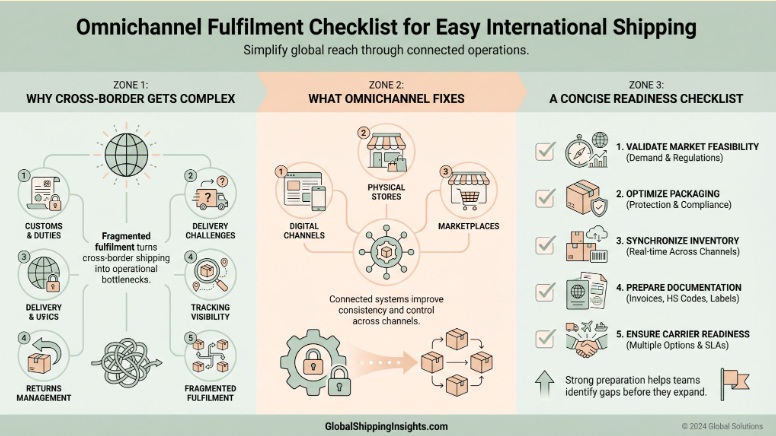
Omnichannel Fulfilment Checklist for Easy International Shipping
Expanding into international markets can unlock new revenue, new customers, and new growth opportunities, but it also introduces complexity fast. Customs, duties, packaging requirements, delivery expectations, tracking, and returns all become harder to manage once you start shipping across borders.
If your fulfilment setup is still fragmented across channels, those challenges can quickly turn into operational bottlenecks. That matters even more as cross-border ecommerce continues to broaden globally.
Avalara’s State of Global Cross-Border E-Commerce report noted that the share of consumers reporting that their most recent cross-border online purchase was made outside the five largest markets rose from 23% in 2016 to 31% in 2022.
Omnichannel fulfillment connects your inventory, orders, shipping, and returns across channels, enabling you to fulfil international orders with greater consistency and control.
With the right setup, you can manage international fulfilment more consistently and with far better control. Now, let’s move straight into the operational checklist you should complete before expanding.
Quick Pre-expansion Checklist
Before you start shipping internationally, make sure you can answer yes to most of the following:
- We have checked market demand and delivery feasibility for each target country
- We understand product restrictions, duties, and labelling rules in each destination
- Our packaging is suitable for international transit and carrier requirements
- Our inventory is synced across all active sales channels
- Our customs documents can be generated accurately and consistently
- We have selected carriers based on cost, speed, reliability, and destination coverage
- Customers can track orders clearly across the delivery journey
- We have a plan for delays, failed delivery attempts, and customer notifications
- Our returns and reverse-logistics process is defined before launch
- We have reviewed country-specific compliance requirements before selling
1. Market and Destination Checks
Before adding a new country, check whether the market is commercially and operationally viable.
What to review
Demand for your products in that market
Shipping cost versus average order value
Delivery timelines that customers are likely to accept
Import duties, taxes, and clearance processes
Product restrictions or prohibited categories
Local language or labelling requirements
Customer expectations around delivery and returns
Practical checklist
- List your first 3 to 5 priority countries
- Confirm whether your products are allowed into each market
- Estimate landed cost before launch
- Review whether long delivery times will weaken conversion
- Check whether your support team can manage customer queries from those markets
The current draft covers market research, product restrictions, and labelling requirements. Combine these into a single operational section rather than distributing them across the introduction.
2. Product and Packaging Readiness
Not every product is equally suitable for international shipping. Before expanding, review what you are shipping and whether the packaging is fit for long-distance transport.
What to review
Size and weight
Fragility and risk of damage
Shelf life, if applicable
Exposure to heat, moisture, or rough handling
Carrier size and weight restrictions
Need for local-language labels, inserts, or customs markings
Practical checklist
- Identify which SKUs are viable for international shipping
- Exclude bulky, fragile, or low-margin products if the fulfilment cost is too high
- Standardise export-ready packaging specifications
- Confirm packaging materials are durable enough for longer transit
- Check carton dimensions against carrier rules
- Test a sample shipment before scaling
Your current draft includes solid points on product selection, sturdy materials, standardised packaging, and carrier compliance. These are essential for export, and the next step is ensuring real-time inventory sync across all channels.
3. Inventory Sync Across Channels
This is one of the most important operational checks. If your website, marketplaces, and internal fulfilment systems are not synced, international shipping can create overselling, stockouts, and costly fulfilment errors.
What to review
Whether inventory updates in real time across all sales channels
Whether international orders pull from the same stock pool
Whether warehouse or store allocation rules are clearly set
Whether stock buffers exist for key export SKUs
Practical checklist
- Sync inventory across the website, marketplace, and fulfilment systems
- Decide whether international stock will come from a shared or dedicated pool
- Set minimum stock thresholds for export-ready products
- Confirm backorders and overselling protections are active
- Test whether an order from each sales channel reduces stock correctly
The draft already mentions real-time inventory visibility and avoiding stockouts, which are crucial. After confirming inventory readiness, the next step is to set up customs documentation.
4. Customs Documentation Setup
International expansion gets messy quickly when customs paperwork is inconsistent. Documentation errors can lead to delays, fines, returned parcels, or confiscated shipments.
What to prepare
Commercial invoices
Packing lists
Certificates of origin, where required
Product descriptions that are specific and accurate
Correct declared values
Commodity or tariff codes, where relevant
Practical checklist
- Create a standard customs documentation workflow
- Check what documents each destination country requires
- Make sure product descriptions are detailed enough for customs review
- Assign responsibility for document accuracy
- Automate document generation where possible
- Review a sample shipment file before launch
To ensure strong transitions, consider introducing this section as highly actionable and worth keeping near the top of the article.
5. Carrier and Delivery Service Selection
Do not choose an international carrier solely on price. The wrong service level can create slow delivery, poor visibility, customs delays, and unhappy customers.
What to compare
Cost
Transit time
Destination coverage
Customs clearance capability
Tracking quality
Delivery reliability
Support for failed delivery attempts
Practical checklist
- Shortlist at least 2 to 3 carriers or fulfilment partners
- Compare economy versus express options by market
- Check delivery performance by destination country
- Confirm who handles customs clearance
- Review the carrier's claims process for lost or damaged parcels
- Align delivery options with customer expectations, not just internal cost targets
6. Tracking Visibility and Customer Notifications
Tracking is not a nice-to-have in international shipping. It is one of the main ways customers judge whether the order experience feels trustworthy.
What to review
Whether tracking links are reliable and easy to access
Whether milestone notifications are automated
Whether customers are informed about delays or exceptions
Whether support can see the same tracking data that customers see
Practical checklist
- Enable tracking for every international order
- Send confirmation, dispatch, in-transit, and delivery notifications
- Set alerts for exceptions such as customs holds or failed delivery attempts
- Make sure customer support can view live shipment status
- Check that tracking updates are understandable to end customers
The draft’s sections on real-time tracking, proactive communication, and delivery exceptions should stay. To further strengthen operations, address returns and reverse-logistics planning next.
7. Returns and Reverse-logistics Planning
Many brands focus on outbound shipping and forget that returns can be even harder internationally. That mistake becomes expensive fast.
What to define
Whether international returns are accepted
Return windows by country
Return shipping responsibility
Refund versus exchange rules
Where returned goods are sent
Whether returned stock can be resold
Practical checklist
- Create a country-by-country returns policy before launch
- Decide whether returns go to a local hub, warehouse, or central facility
- Calculate the cost of return shipping and reverse handling
- Set customer expectations clearly at checkout and in FAQs
- Prepare internal workflows for damaged, refused, or undeliverable items
This section is missing from the draft and should be included, as it is vital for a complete international shipping checklist. Once returns are addressed, ensure you review compliance for each country before launching.
8. Country-specific Compliance Checks
International expansion is not just about parcels moving from one country to another. Each destination may have its own rules around labelling, documentation, restricted goods, declarations, or sector-specific compliance.
What to review
Product restrictions by market
Mandatory labels or documentation
Tax and duty treatment
Sector-specific rules for health, food, electronics, cosmetics, or regulated goods
Customer-facing disclosures needed at checkout
Practical checklist
- Check product admissibility for every destination
- Review local packaging and labelling rules
- Confirm whether duties and taxes are prepaid or collected on arrival
- Update your checkout messaging to reflect realistic delivery and customs expectations
- Recheck compliance before adding new products to export markets
The current draft discusses restrictions, labels, and customs requirements, but dedicates a separate section to them due to their significance as compliance risks. With compliance processes in place, operational ownership within your team is the final step for successful expansion.
9. Internal Operational Ownership
International shipping fails when ownership is vague. Before launching, make sure your internal team knows who is responsible for each part of the workflow.
Practical checklist
- Assign ownership for inventory accuracy
- Assign ownership for customs documentation
- Assign ownership for carrier management
- Assign ownership for exception handling
- Assign ownership for customer communication
- Document escalation paths for delayed, stuck, or rejected shipments
This is another addition worth making because it turns the article into a page teams can actually use.
10. Pre-launch Testing Before Full Rollout
Do not treat the first live customer orders as your test phase. Run controlled checks before expanding fully.
Practical checklist
- Place test orders from each live sales channel
- Test fulfilment from order creation to dispatch
- Validate customs paperwork on sample shipments
- Review tracking messages and delivery notifications
- Simulate a failed delivery or customs delay workflow
- Test the returns process before publishing it
This is one of the best ways to make the article feel practical rather than theoretical.
International Shipping Readiness Table
Final Thoughts
For businesses planning to expand internationally, this page should do more than explain the concept of omnichannel fulfilment. It should help you assess whether your operations are actually ready for cross-border growth.
That means focusing less on broad theory and more on the practical checks that affect launch success, from inventory sync and customs documentation to carrier selection, returns planning, and market-specific compliance.
The real value of this article is in making expansion feel more actionable. A strong version should help readers identify gaps early, assign ownership clearly, and move forward with greater confidence. If the checklist is doing its job well, the takeaway should be simple: we know what needs to be in place before we expand.
If you want to strengthen your international fulfilment setup before entering new markets, Airpak Express can help you build a more connected omnichannel operation across inventory, shipping, tracking, and returns.
Speak to our team to explore a fulfilment model that supports smoother cross-border execution and better control as you grow.

No time to manage complex post-shipment invoicing? Airpak ShipNow is your answer.
Prepaid shipping service catering to all your logistics needs.
Book and send your shipment with less than 5 clicks of the mouse!
Time to scale up your business. Let us handle the complexity of logistics management.
Register and create an account with us for seamless online ship management.
Access and manage all your shipments through one portal.